03.06.2016• Modular Buildings
Temporary Buildings for Business: A Smarter Way to Grow Without the Risk

Updated April 2026
Growth is rarely predictable. One quarter, you need more space, more staff, and more storage; the next, things level out. And these are turbulent economic years, which can be a trial for any business. So if you see an opportunity to maximise your growth, you have to take it, right?
The problem is, for many businesses, this brings with it the need for physical expansion in order to accommodate more equipment, people and/or products. So, do you commit to a permanent expansion or risk holding back growth altogether?
Traditional construction doesn’t offer much middle ground. It’s expensive, time-consuming, and designed for long-term commitment – even when your needs aren’t.
It’s for this reason that many businesses are turning to temporary modular buildings as a solution to their space problems. Not as a compromise, but as a smarter, more flexible way to create space exactly when it’s needed. So what are their main benefits?
A Solution That Moves at Your Speed
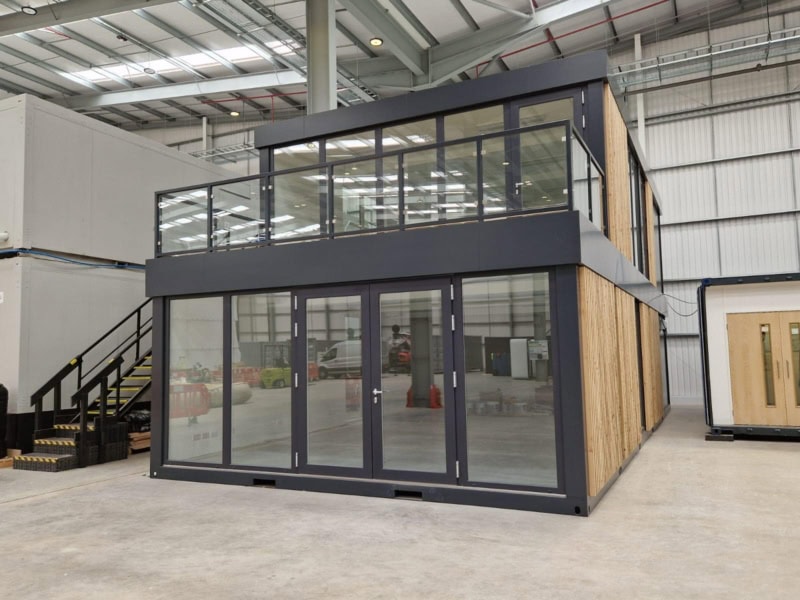
The most popular benefit of temporary modular buildings is speed. Since they don’t require foundations, temporary buildings can be installed quickly and efficiently, sometimes in as little as four days. When space becomes a bottleneck, this timing matters, since delays can mean missed opportunities, operational inefficiencies, or stalled growth.
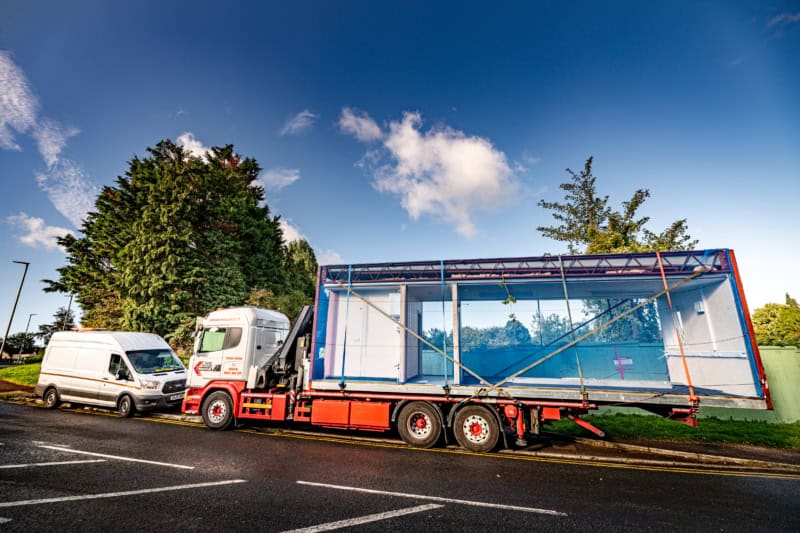
Portable modular buildings are designed to respond quickly. The materials are readily available, saving you time on procurement and logistics. They’re also quick to transport to the site, so you can save a significant amount on shipping costs, compared to materials used in more traditional constructions.
This allows businesses to react in real time – whether that’s scaling up operations, accommodating new staff, or supporting a short-term project.
Just as importantly, when that need changes, the building can be removed or relocated just as efficiently. At PF Modular, we even offer buy-back options as an added bonus.
Reducing Financial Risk
One of the biggest challenges with traditional expansion is commitment and costs. Leasing new premises or constructing a permanent extension locks you into long-term costs, no matter how your business evolves.
Temporary buildings offer a different approach.
Since temporary buildings follow a pre-fabricated modular style, you won’t be wasting money on expensive architects’ fees. Neither will you be faced with expensive builders’ costs because these structures can be assembled quickly, without the need to dig foundations.
And if your supplier offers a buy-back option, as we do, you are faced with almost zero risk to your business or your schedule.
Built for Change, Not Just Use
The word “temporary” can be misleading. It often suggests something basic or short-lived, but modern temporary buildings are designed to perform, no matter their current use.
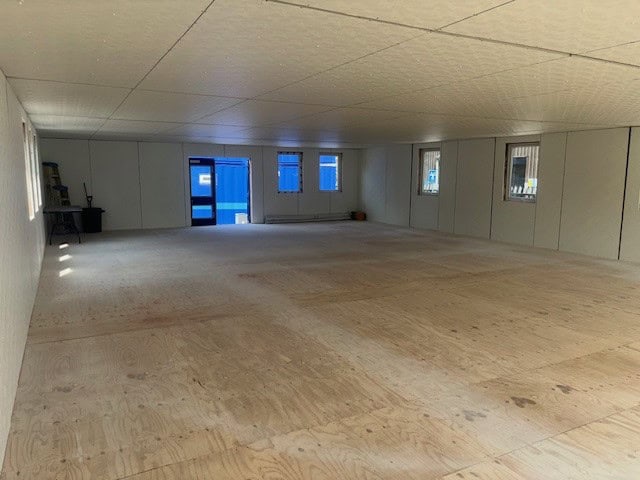
They meet all UK safety standards, provide comfortable, functional environments, and can be tailored to a wide range of uses. Also, components can be added or removed as your business needs change, and the structures can be altered to suit any new business requirements.
As your business evolves, so can the building. It can be extended, reconfigured, relocated, or removed entirely, without the disruption and cost associated with traditional construction.
For businesses, this offers a quick, smart solution to commercial problems like space requirements and relocation. You can build, dismantle, extend, return, relocate or modify your structure at the drop of a hat.
(c) Andrew Hobbs Photography
Minimising Disruption to Operations
Construction projects can be disruptive by nature. Noise, restricted access, and on-site activity can all interfere with day-to-day operations.
Temporary modular buildings reduce that impact by a huge margin. Because the majority of the build takes place off-site, installation is quick and controlled, with far less interference to your working environment.
For businesses that need to remain fully operational throughout expansion, this is a major advantage.

A Practical Alternative to Permanent Expansion
Not every change in your organisation justifies a permanent solution. In many cases, businesses simply need space for a specific period of time, whether that’s months or a few years.
Temporary buildings fill that gap perfectly. They allow you to expand when needed, without overcommitting resources or locking yourself into long-term decisions.
And if that “temporary” need becomes permanent? The building can often remain in place, upgraded or adapted to suit longer-term use.
This is why temporary buildings are no longer just a desperate short-term solution. They’re a strategic tool that allows businesses to grow, adapt, and respond without unnecessary risk.
In a business environment where flexibility is becoming just as important as stability, that’s a powerful advantage.
Ready to Create Space Without the Commitment?
At PF Modular, we provide high-quality temporary buildings designed around real business needs – whether you require additional space for a few months or a flexible solution that can evolve over time.
If you’re exploring ways to expand without the long-term risk, our team can help you find the right solution quickly and efficiently. Give us a call at 01420 587880 to discuss your business needs and how we can help make it happen.
Related Posts
16.09.2026• Modular Buildings
Traditional vs. Modular: A Cost-Benefit Analysis for Growing SMEs
For a growing SME, needing more space is usually a good problem to have. More employees, new contracts, additional equipment or an expanding operation...
Continue Reading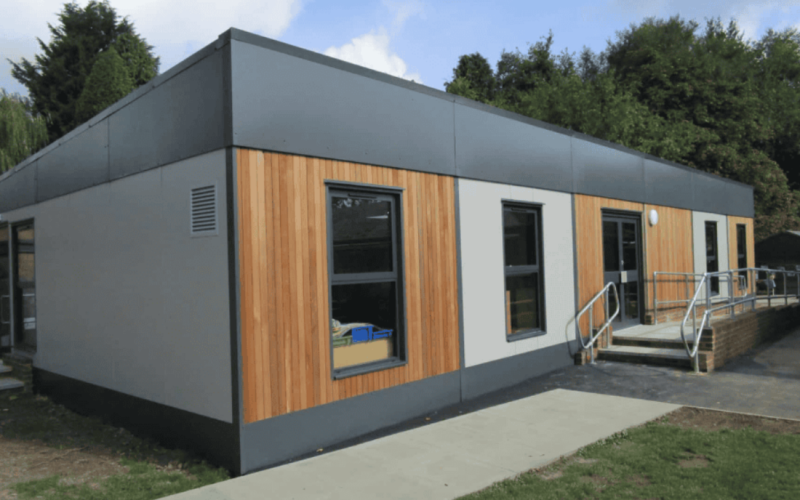
09.09.2026• Modular Buildings
The Hybrid Hub: Why Satellite Offices Are Replacing the Central Headquarters
The word “headquarters” signifies the unquestioned centre of business. Employees travel to it, teams are organised around it, and workspace strategy largely involves deciding...
Continue Reading
12.08.2026• Modular Buildings, Posts & News
SEN-Friendly Design: Creating Inclusive Learning Spaces in Modular Classrooms
When discussing SEND provision, the conversation tends to revolve around staffing, funding, interventions and curriculum. The building itself is rarely even on the docket....
Continue Reading